

Documentary Interview Techniques That Reveal Truth

The most revealing sentence in a documentary often arrives after the polished answer ends. A subject pauses, looks away, and starts again: “What I mean is...” That moment cannot be forced, but it can be invited. Strong documentary interview techniques create the conditions for people to speak with precision, feeling, and trust - while giving editors the material needed to shape a cinematic, credible story.
For corporate leaders, legal professionals, nonprofit advocates, founders, families, and event clients, the interview is rarely just a talking head. It is the narrative engine of the film. When it is handled with care, the audience sees more than a spokesperson or subject. They see a person with stakes in the story.
Start With Story, Not Questions
A weak interview begins with a questionnaire. A powerful one begins with a point of view: What should an audience understand, feel, or reconsider by the end of this film?
Before production, identify the subject’s role in the larger narrative. A CEO may explain the origin of a company, but a customer may reveal its real-world impact. A bride can describe the details of a wedding day, while a parent may provide the emotional history that gives those details meaning. The goal is not to make every participant say the same thing. It is to build a set of perspectives that complete one another.
Pre-interviews are one of the most valuable parts of the process. A relaxed phone or video conversation helps a producer identify vivid memories, potentially sensitive subjects, unclear claims, and language the speaker naturally uses. It also prevents a common mistake: spending valuable production time discovering the story from scratch.
Research matters especially in professional environments. For a law firm, healthcare-adjacent organization, or regulated business, the team should understand what can be discussed on camera and what must remain confidential. Preparation protects the client, the subject, and the integrity of the final film.
Build Questions That Invite Scenes
Questions should lead people toward moments, not slogans. “Tell us about your company” typically produces a broad, rehearsed response. “What did you see on the day you realized this problem needed to be solved?” gives the subject a place, a time, and an emotional entry point.
Ask for specifics: what they saw, heard, thought, feared, or decided. Follow-up questions do the real work. If a subject mentions a difficult turning point, ask what made it difficult. If they say a result was meaningful, ask who was affected and how.
Avoid stacking multiple questions into one prompt. People usually answer only the final question they hear, leaving the strongest material unexplored. One clear question, followed by attentive listening, is more effective than an impressive-sounding script.
Documentary Interview Techniques That Build Trust
The camera can make even confident people self-conscious. The production team’s job is to lower that pressure without lowering the standard. A quiet, organized set signals professionalism. A subject who knows where to sit, where to look, how long the conversation may take, and what will happen next can focus on the story instead of the equipment.
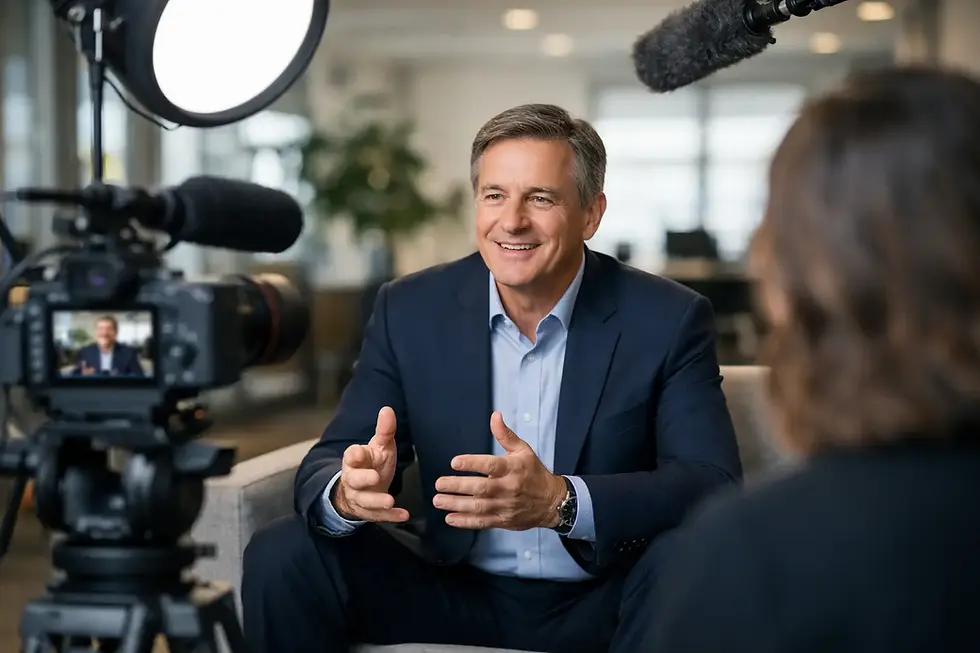
Whenever possible, interview subjects should speak to an interviewer positioned just off camera rather than directly into the lens. This creates a natural conversational eyeline and makes the viewer feel like an observer of an honest exchange. Direct-to-camera can be effective for a deliberate address or personal appeal, but it should be a creative decision, not the default.
The interviewer should maintain eye contact, react naturally, and avoid interrupting a developing answer. Silence is useful. Many people rush to fill a pause, and the next sentence is often more thoughtful than the first. Give an answer room to breathe before moving on.
It also helps to remove the pressure to be perfect. Let subjects know they can pause, restart, or rephrase. In most cases, the strongest delivery comes after the speaker realizes they do not have to perform. They simply need to tell the truth clearly.
Ask for Full-Sentence Answers Without Breaking the Flow
Editors need answers that make sense when the question is removed. A one-word reply or a sentence beginning with “because” can be difficult to use in a finished documentary.
Rather than repeatedly instructing subjects to restate the question, guide them conversationally. If the prompt is, “Why did you choose this work?” a useful response begins with, “I chose this work because...” This small adjustment creates clean, flexible sound bites while preserving a natural voice.
Do not overcorrect every answer. Some fragmented or imperfect language carries genuine emotion. The balance depends on the film’s purpose. A polished brand documentary may require concise, well-framed statements, while a personal story can benefit from pauses, repetitions, and vulnerability.
Shape the Frame With Purpose
Visual choices affect whether an interview feels generic or cinematic. The setting should reveal something about the subject without distracting from them. A founder in a thoughtfully designed workspace, an artist surrounded by materials, or a family member in a meaningful home environment gives the audience visual context before a word is spoken.
Depth is critical. Positioning the subject too close to a flat wall can make an otherwise well-lit interview feel like a basic office recording. Separating the subject from the background, using practical lights, and choosing a lens with an appropriate focal length creates dimension and focus.
Lighting should flatter the subject while serving the story. Soft, controlled key lighting can feel refined and trustworthy for executive interviews. More directional lighting may support a serious investigative or dramatic tone. What matters is consistency: a film with multiple interviews should feel like one visual world, even when locations differ.
Sound deserves equal attention. Audiences may accept an imperfect image for a moment, but they quickly disengage from echo, traffic noise, clothing rustle, or inconsistent audio levels. A professional production uses close microphone placement, monitors audio continuously, and records a few moments of room tone for clean post-production transitions.
Direct for the Edit, Not Just the Moment
An interview can feel excellent in the room and still fail in post-production if it lacks coverage, context, or usable transitions. Directors should listen for statements that establish the beginning, tension, change, and outcome of a story.
If a powerful answer is buried halfway through a long response, ask for it again in a shorter form. This is not manipulation. It is a practical way to help the subject express their most valuable point with clarity. A simple request such as, “That was strong. Could you say that once more, starting with what changed?” can save an edit.
Capture visual cutaways and b-roll that support what the subject says. Hands at work, interactions with colleagues, preparation before an event, archival photographs, location details, and candid moments all help the editor move through the interview without relying on constant cuts. The b-roll must be relevant, however. Attractive but unrelated footage can weaken credibility.
For multi-camera productions, keep technical settings aligned and ensure eyelines remain consistent. A second angle adds editorial flexibility, but only when it feels intentional. The same principle applies to branded environments: logos, screens, documents, and client information should be checked carefully before recording.
Handle Emotion and Sensitive Stories With Discipline
Some interviews involve grief, conflict, trauma, legal matters, health concerns, or deeply personal milestones. The best approach is not to push for tears or dramatic statements. It is to give the subject control, time, and clear boundaries.
Explain the purpose of difficult questions before asking them. Let participants know they can decline to answer, pause filming, or revisit a topic later. If emotion arises, stay present without exploiting it. A calm interviewer may ask whether the person wants a moment, water, or a chance to continue. Respect is not separate from quality. It is what makes a truthful story possible.
For business documentaries, sensitivity also means accuracy. Do not encourage subjects to make unsupported claims, reveal confidential information, or speak beyond their expertise. Credibility comes from clear testimony, thoughtful visuals, and editorial restraint.
The Best Interviews Feel Like Conversations
Premium documentary work is built through preparation, technical control, and the human ability to listen. The equipment matters. So do the lighting design, camera placement, sound capture, and post-production craft. But none of those elements can replace a subject who feels safe enough to say something real.
At Afrang Media Productions, that standard guides every interview-led project, from brand films and executive profiles to personal milestone stories. Give people a well-prepared space, ask questions worth answering, and leave room for the unexpected. That is where a documentary stops sounding produced and starts feeling true.


Comments